News
2026-09-06
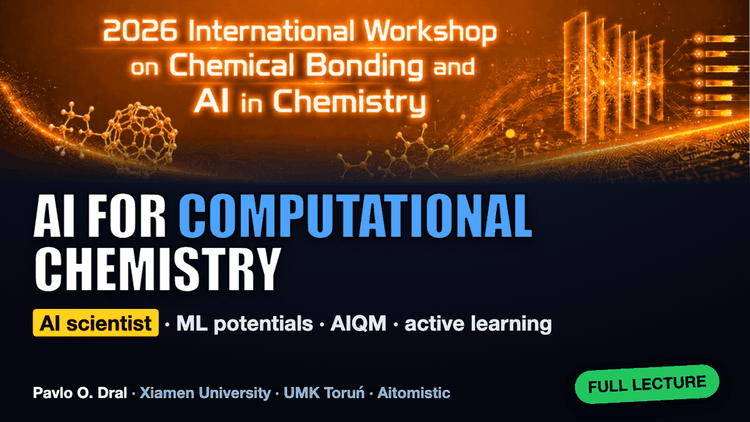
Full lecture: from ML potentials to agents that write the paper — AI for computational chemistry
Prof. Pavlo O. Dral gave the AI lecture at the 2026 International Workshop on Chemical Bonding and AI in Chemistry on 29 August — organised by the College of Chemistry and Chemical Engineering at Xiamen University and the Fujian Provincial Key Laboratory of Theoretical and Computational Chemistry, and held online over three evenings. Our thanks to the organisers for sharing the video and permitting its reuse.
2026-08-28
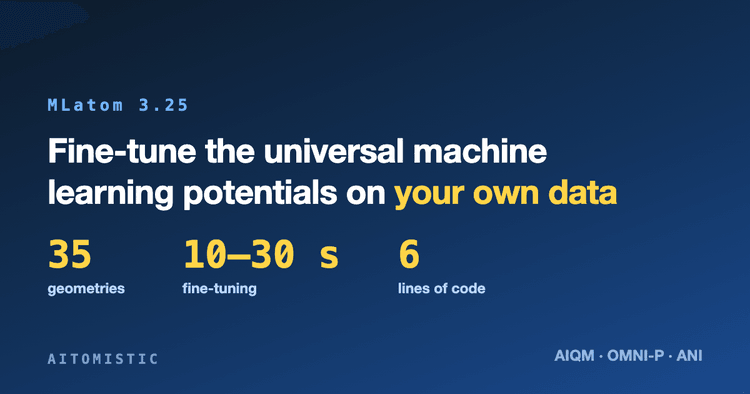
MLatom 3.25: fine-tune the universal machine learning potentials on your own data
In MLatom 3.25 the whole family — ANI, AIQM1, AIQM2, AIQM3, UAIQM, OMNI-P1 and OMNI-P2x — fine-tunes through the same train() call, with dispersion declared once and handled on both sides. On ethanol, thirty-five training geometries close AIQM2's gap to its target from 1.37 to 0.67 kcal/mol, in ten to thirty seconds a run.
2026-08-21
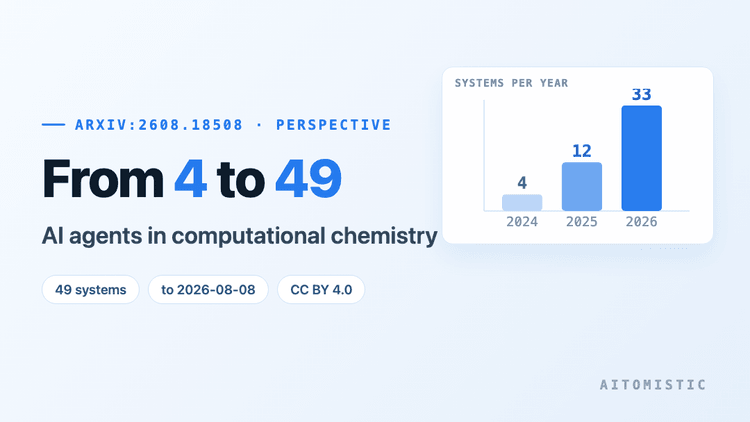
Science Done on a Machine by a Machine: AI Agents in Computational Chemistry
A Perspective surveying 49 agentic systems for computational chemistry to a cutoff of 8 August 2026: what they do, how much of a study each is handed, what runs them, how much of it a reader can actually obtain — and where this is heading.
2026-08-03
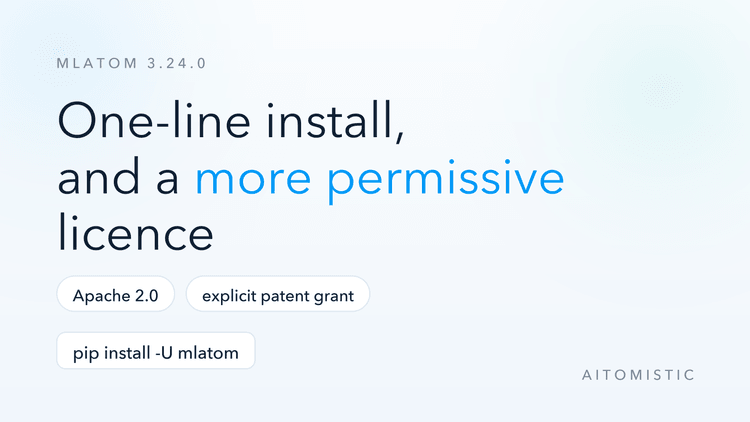
MLatom: one-line install, and a more permissive licence
MLatom 3.24.0 installs with a single pip command and is now released under the Apache License 2.0.
2026-07-15
Find a transition state — just by chatting (Protomia 2.6.0)
One prompt → NEB path → the TS → imaginary mode → IRC → the reaction energy diagram.

2026-07-01
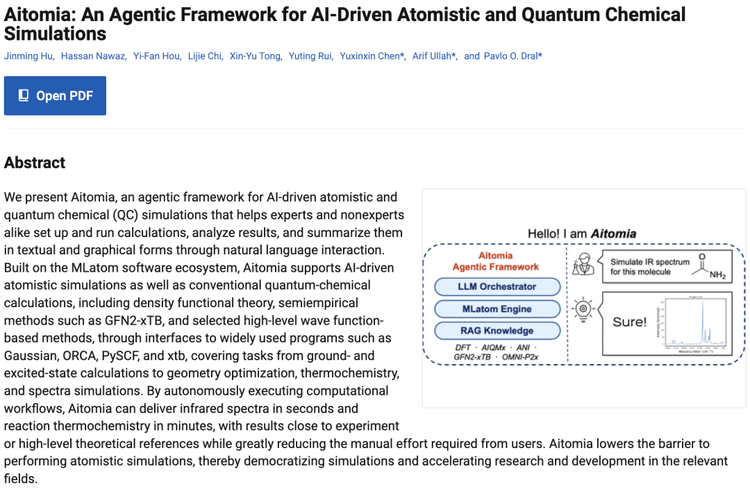
Our Aitomia Framework Is Published in JCTC
Read the paper to see where it started; open Protomia to see where it's going.
2026-06-22
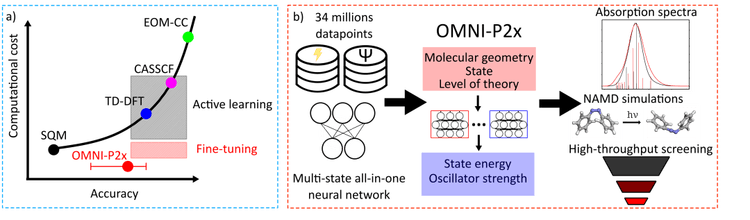
Nature Communications: OMNI-P2x Universal Neural Network Potential for Excited-State Simulations
OMNI-P2x is the first universal neural network potential for ground and excited electronic states for a chemical space of small molecules.
2026-06-01
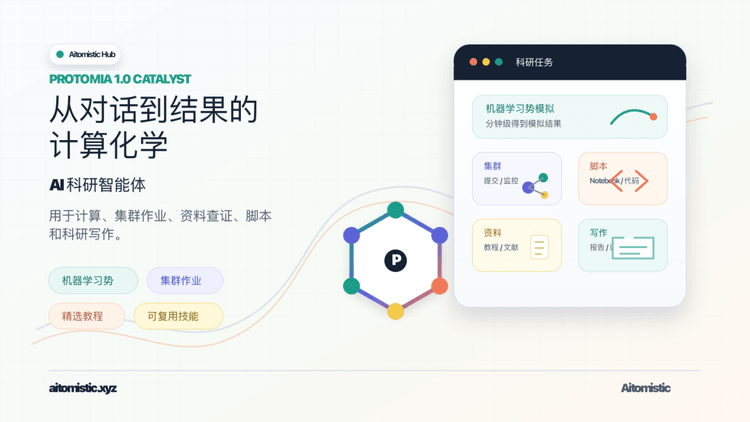
Protomia 1.0 Catalyst: From Conversation to Scientific Discovery
Protomia 1.0 Catalyst: computational chemistry from conversation to results.
2026-03-26
Introducing Protomia – Be the First To Try Out the Alpha Version
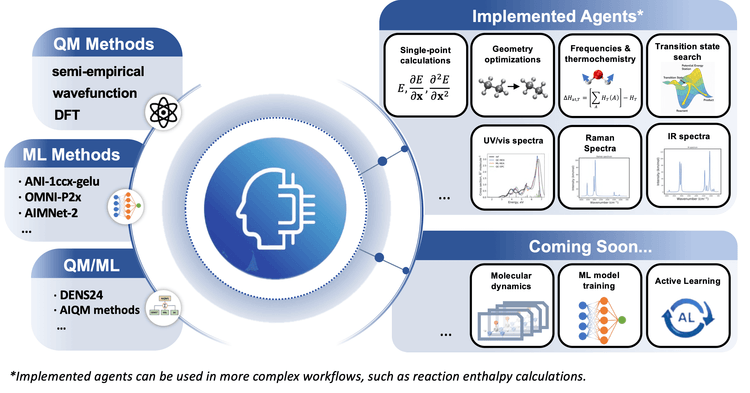
Protomia builds on the ideas introduced in Aitomia: faster responses, clearer file and folder structure, detailed logs, and improved stability.
2025-12-01
Aitomistic Updates: One to Rule Them All——A Universal Interatomic Potential Learning across Quantum Chemical Levels
Our all-in-one learning strategy elegantly solves this problem by simultaneously training a potential on different datasets.

2025-11-24
Aitomistic Updates: Tools for analyzing your simulations
In this week’s newsletter, we’d like to highlight a powerful feature of MLatom (an open-source software supported by Aitomistic) as a tool for analysis of your calculations, e.g., with Gaussian.
2025-11-17
Aitomistic Updates: Conical Intersection Optimization, Langevin Thermostat MD, and New Active Learning Research
In this weekly briefing, you will learn about the aitomistic updates, including implementations in the newly released open-source MLatom 3.19.1, a new publication, and a preview of upcoming course updates and features for premium users.

2025-11-10
Aitomistic Updates: IRC Calculations, AIQM3, and New ML Research
Here is your weekly dose of exciting updates around aitomistic simulations from our team, including IRC, a video lecture and new publication, and preview of upcoming features.

2025-08-21
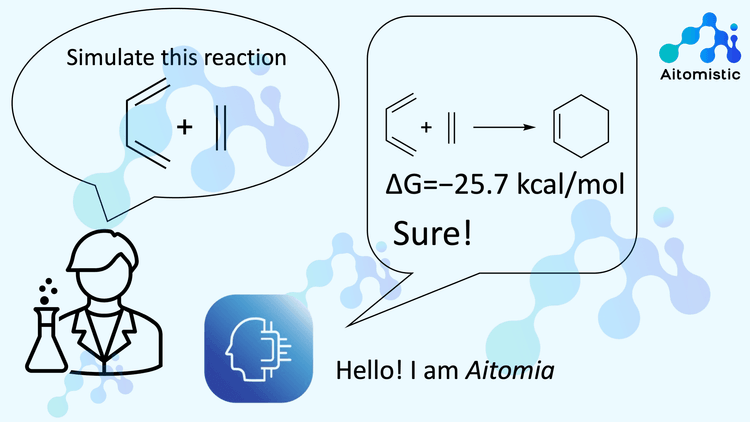
Aitomia: Reaction simulation in 5 minutes without human help
This Deep Thinking mode, enabling increasingly complex autonomous computational chemistry simulations, is already enabled for selected users on the Aitomistic Hub.
2025-08-16
Chemical Science: “AIQM2: Organic Reaction Simulations Beyond DFT”
It can be used for TS structure search and reactive dynamics, often with chemical accuracy.
2025-08-11
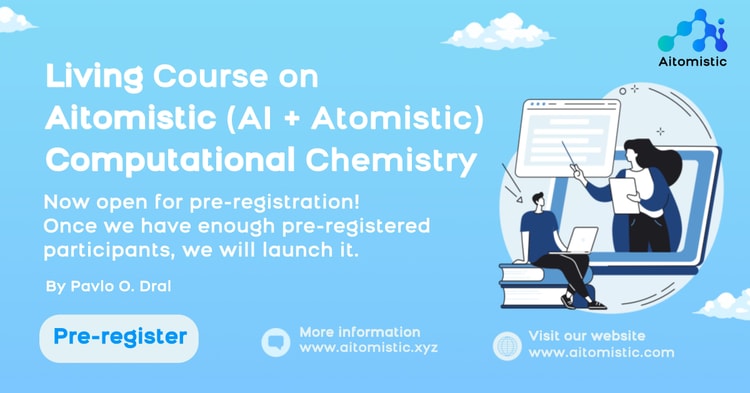
Living Course on Aitomistic (AI + Atomistic) Computational Chemistry
This continuously updated course is created and maintained by an active, internationally recognized expert in the field.
2025-07-30
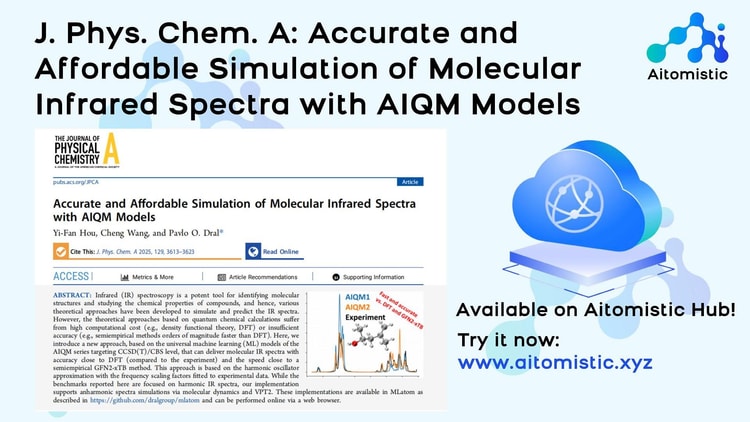
JPCA: accurate and affordable IR spectra with AIQM
We published a paper in JPCA about the accurate and affordable simulation of gas-phase infrared spectra with AIQM models.
2025-07-15
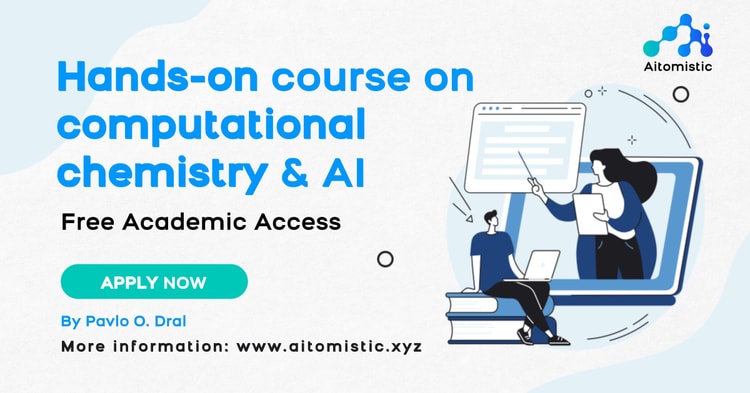
Free Academic Access to Computational Chemistry & AI (July 2025 Edition)
The July 2025 Edition of the hands-on online course Computational Chemistry & AI by Pavlo O. Dral is now available free of charge for academic users.
2025-06-05
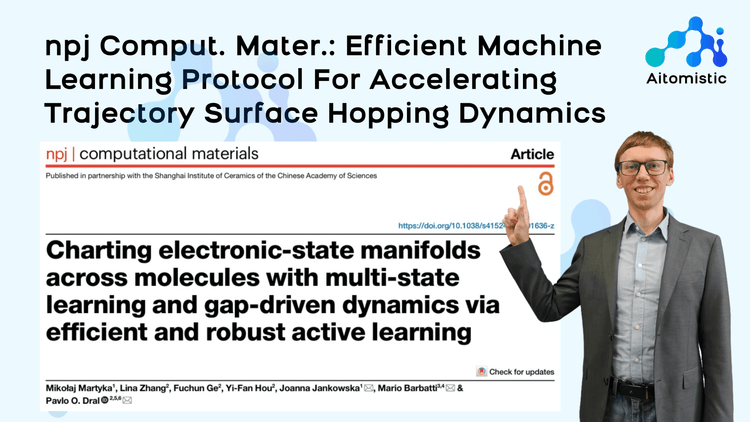
npj Comput. Mater.: Efficient Machine Learning Protocol For Accelerating Trajectory Surface Hopping Dynamics
The protocol introduces a new machine learning interatomic potential based on multi-state learning and accelerated sampling of the critical regions near conical intersections.
2025-05-19
Aitomia: Your Intelligent Assistant for AI-Driven Atomistic and Quantum Chemical Simulations
A user-friendly intelligent assistant with expert knowledge in AI-driven atomistic (“aitomistic”) and quantum chemical simulations.

2025-05-15
Meet OMNI-P2x — the First Universal ML Potential for Excited States!
Are universal machine learning potentials for excited states possible? We’re excited to share: they are possible. We’ve built the first-ever universal excited-state potential — OMNI-P2x.

2025-05-06
Aitomistic Hub Launched!
Beta version is live! Try it now and be among the first to explore the latest features—early adopters who provide feedback will get a chance at free perks and discounts for future versions!